You've been sleeping reasonably well, eating decently, and still notice something's quietly shifted drive, stamina, edge. The first instinct is to start reading ingredient labels and, eventually, PubMed. When you land on a formula built around shilajit and oyster peptides, the real question isn't whether ancient ingredients sound compelling. It's whether the biochemistry actually holds up. It does and the reason is more specific than "they support testosterone." These two compounds target different bottlenecks in the same hormonal system, which is what makes the combination worth understanding on its own terms.
MyCern is a US-based wellness brand creating research-supported, doctor-reviewed educational content.

Medically Reviewed
Dr. Donika Vata, MD kyla
Physician & Medical Researcher
Dr. Donika Vata bridges the gap between natural remedies and modern medicine, reviewing our content to guarantee scientific accuracy and safety.
Support your foundational vitality — from the inside out.
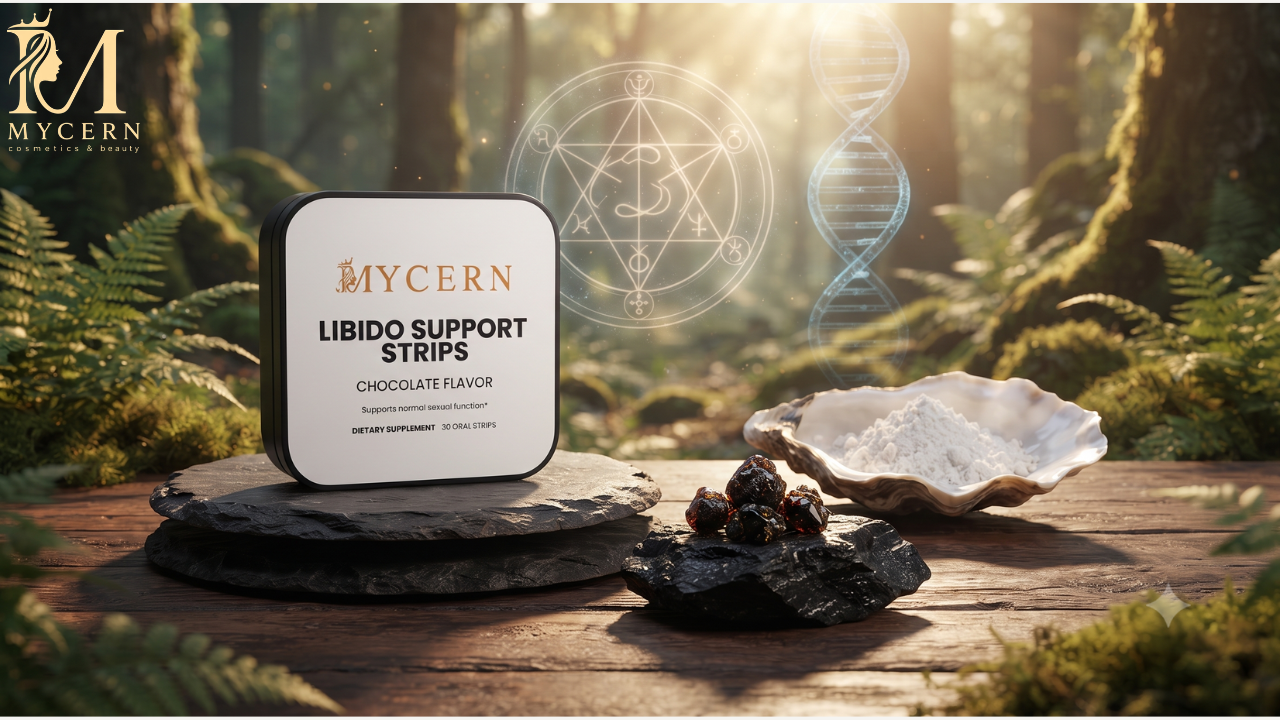
MyCern Libido Support Strips combine standardized shilajit extract and oyster peptide concentrate in one fast-dissolving oral strip. No capsules, no fillers, no guesswork.
Shop Now →Your Hormonal System Has More Than One Bottleneck

Testosterone production isn't a single switch. It depends on a chain of interlinked processes: mitochondrial energy availability, zinc concentrations, Leydig cell signaling, and vascular nitric oxide activity each play a role. Compromise any one of those and the whole system can underperform. That's why single-ingredient approaches often produce results that feel modest they're addressing one point on a multi-step pathway.
Shilajit and oyster peptides happen to operate on four of those points, none of them overlapping. One works at the upstream energy-transport level. The other works at the mineral, cellular synthesis, and vascular levels. That's the non-redundancy worth understanding before you write either off as folklore.
What Shilajit's Fulvic Acid Actually Does at the Cellular Level
Shilajit is a mineral-dense resin that seeps from high-altitude Himalayan rock, formed over millions of years from compressed organic plant matter. Its primary bioactive, fulvic acid, functions as a membrane-active transporter it escorts minerals and nutrients across cell membranes more efficiently than those compounds travel on their own. In Leydig cells specifically, where testosterone is synthesized, better energy availability through improved mitochondrial function translates directly to greater steroidogenic output.
The clinical evidence here is unusually precise. A randomized, double-blind, placebo-controlled trial published in Andrologia gave healthy men aged 45–55 purified shilajit standardized to at least 50% fulvic acids (250 mg twice daily) for 90 days. Compared to placebo, the treatment group showed significantly higher total testosterone, free testosterone, and DHEAS.[1] Notably, gonadotropic hormone levels (LH and FSH) remained stable throughout suggesting the outcome reflected improved downstream efficiency rather than hypothalamic overstimulation. That distinction matters if you're trying to understand how sustainable the effect is.
Oyster Peptides: Zinc Is Just the Starting Point
The zinc-testosterone relationship is one of the better-studied mineral connections in male health. Research published in Nutrition showed that restricting dietary zinc in healthy young men for 20 weeks dropped serum testosterone from roughly 40 nmol/L to around 11 nmol/L — nearly a 75% reduction. Supplementing marginally zinc-deficient older men for six months roughly doubled their levels back.[4] Oysters are among the most concentrated natural sources of bioavailable zinc. But that's where the simple story ends.
Enzymatic hydrolysis of Crassostrea oysters produces bioactive peptides that directly stimulate testosterone secretion and nitric oxide synthase (NOS) activity in Leydig cells, while elevating cyclic AMP an intracellular messenger that amplifies the androgen signal.[2] At the same time, three specific oyster-derived dipeptides (RI, IR, and VR) were found to clear reactive oxygen species from Leydig cells and upregulate the key enzymes in the testosterone synthesis pathway a direct antioxidant-to-androgen mechanism that zinc supplementation alone can't replicate.[5] And at the vascular level, a 2025 peptidomic study screened 3,202 Pacific oyster peptides and identified five that selectively inhibit PDE-5 the enzyme that degrades cGMP, the molecule responsible for smooth muscle relaxation and blood flow.[3] That's vascular support from a food-derived source, at the peptide level.
How the Two Ingredients Cover Different Group
Here's the clearest way to see why neither ingredient makes the other redundant:

| Ingredient / fraction | Primary mechanism studied | Pathway |
|---|---|---|
| Shilajit (fulvic acid) | May support cellular energy transport and mitochondrial efficiency in Leydig cells | Upstream energy production |
| Oyster peptides (zinc) | Replenishes the mineral cofactor required by testosterone-synthesizing enzymes | Mineral / enzymatic |
| Oyster dipeptides (RI, IR, VR) | Reduces oxidative stress in Leydig cells and upregulates steroidogenic enzymes | Androgen synthesis (cellular antioxidant) |
| Oyster PDE-5 peptides | Selectively inhibits PDE-5 to slow cGMP degradation and may support vascular signaling | Vascular / blood flow |
No single ingredient covers all four rows. Each addresses a different rate-limiting step. That's not marketing language — it's what the research describes when you look at each compound individually and then compare mechanisms.
Two mechanisms. One strip.
MyCern's Libido Support Strip pairs standardized shilajit extract with oyster peptide concentrate in a fast-dissolving oral format — no water, no capsules, no extras.
Shop Now →How to Use MyCern Libido Support Strips
Place one Libido Support Strip on your tongue and let it dissolve fully no water needed. The oral strip format bypasses the digestive breakdown that reduces bioavailability in many capsule supplements, so active compounds reach the bloodstream faster. Take one strip daily at a consistent time; the testosterone-support benefits associated with shilajit in research reflect sustained daily use (the primary clinical trial ran 90 days, not single doses). Don't exceed the recommended serving and always follow label directions.
Quality, Purity, and What's in the Strip
MyCern Libido Support Strips are manufactured in a facility operating under FDA current Good Manufacturing Practices (cGMPs). The shilajit and oyster peptide extracts in this formula are batch-tested by third-party laboratories, including Eurofins, for heavy metals, purity, and ingredient identity. This matters specifically for shilajit: raw or unpurified resin can carry lead, arsenic, and other contaminants. Independent verification means what's on the label reflects what's in the strip and what isn't on the label isn't in it either.
Not sure which formula fits your goals?
The MyCern Supplement Advisor asks a few quick questions about your health goals, lifestyle, and priorities — then matches you to the right product for your situation.
Find My Match →When to See a Doctor
Supplements are not a substitute for medical evaluation. If you're experiencing persistent low libido, significant fatigue, mood changes, reduced muscle mass, or other signs that may be associated with low testosterone, speak with a licensed healthcare provider. These symptoms may reflect underlying conditions that require clinical assessment and management beyond what a supplement may support.
Men taking medications for cardiovascular conditions, blood-thinning drugs, immunosuppressants, or medications metabolized by the liver should consult a doctor before adding shilajit or oyster peptide supplements. The same applies if you have kidney disease, liver disease, gout, or any chronic health condition. This product is intended for adults only.
Frequently Asked Questions
What do shilajit and oyster peptides do for libido?
Research suggests they may support male libido and vitality by targeting separate points in the same hormonal system rather than hitting the same pathway twice. Shilajit's fulvic acid has been associated with improved cellular energy transport in Leydig cells and, in a 90-day placebo-controlled trial, with significantly higher total and free testosterone. Oyster peptides have been studied for their ability to stimulate androgen synthesis directly in Leydig cells, replenish zinc as a hormonal cofactor, and preserve cGMP through selective PDE-5 inhibition a vascular mechanism. Together, they cover upstream energy, mineral availability, cellular antioxidant-driven synthesis, and vascular signaling: four distinct pathways a single ingredient can't address simultaneously. Results may vary based on individual baseline levels, age, and lifestyle. You can read more about the specific formula in the MyCern Libido Support Strip product page.
Is it safe to take shilajit and oyster peptide supplements every day?
For healthy adults, daily use of standardized, third-party-tested shilajit and oyster peptide supplements is generally well-tolerated in the short-to-medium term. The clinical shilajit trial cited in this article ran 90 days in men aged 45–55 without reported adverse effects at 500 mg daily (250 mg twice). Standardization and purity matter: raw unsourced shilajit may contain heavy metals, which is why third-party testing by laboratories such as Eurofins is important for safety assurance. If you have a shellfish allergy, kidney or liver disease, or take prescription medication, consult a healthcare provider before starting.
How long does shilajit take to work for testosterone?
Based on the most robust published clinical evidence, meaningful changes in testosterone markers were observed after 90 days of consistent daily use not after a single dose or a few days. Some men report noticing improvements in energy or mood within a few weeks, while measurable hormonal changes may take longer. Individual results will vary based on baseline hormone status, age, diet, sleep quality, and the standardization level of the extract. Think of shilajit as a foundational support strategy rather than a fast-acting stimulant. Consistent daily use as indicated on the product label — reflects the protocol studied in the research.
What's the difference between shilajit and ashwagandha for men?
They work through different mechanisms and aren't interchangeable. Shilajit's primary action centers on fulvic acid's role as a cellular transporter, with direct evidence from a placebo-controlled trial of increased testosterone at the gonadal level. Ashwagandha is an adaptogen studied mainly for its ability to reduce cortisol with the hypothesis that lowering chronic stress hormone levels may indirectly support testosterone by reducing cortisol's suppressive effect on the hypothalamic-pituitary-gonadal (HPG) axis. Shilajit acts more directly at the Leydig cell level; ashwagandha acts more broadly at the stress-hormone axis. Both have peer-reviewed research behind them; neither replaces the other, and neither replaces a conversation with your doctor if you're experiencing symptoms of hormonal imbalance.
Who should avoid shilajit supplements?
Pregnant or breastfeeding individuals should avoid shilajit, as safety data in those populations is insufficient. People with kidney disease should be cautious, as shilajit may affect uric acid levels. Men taking blood-thinning medications, immunosuppressants, or medications metabolized by the liver should consult a healthcare provider before use, as interactions have not been adequately studied. Choosing a purified, standardized extract that has been independently tested for heavy metals is important for anyone considering shilajit raw or unsourced forms carry contamination risks. If you have any chronic health condition or take prescription medication, please speak with your doctor before starting this or any supplement. Results may vary.
References
- Pandit S, et al. "Clinical evaluation of purified Shilajit on testosterone levels in healthy volunteers." Andrologia. 2016;48(5):570–575. PubMed 26395129 | DOI: 10.1111/and.12482
A 90-day randomized, double-blind, placebo-controlled trial in men 45–55 found purified shilajit (standardized to ≥50% fulvic acids, 250 mg twice daily) significantly increased total testosterone, free testosterone, and DHEAS vs. placebo — the primary clinical basis for shilajit's testosterone-support association. - Liao W, et al. "Enzymatic preparation of Crassostrea oyster peptides and their promoting effect on male hormone production." Journal of Ethnopharmacology. 2020. PubMed 32918991
Demonstrated that enzymatically hydrolyzed Crassostrea oyster peptides increased testosterone secretion, NOS activity, and cyclic AMP in Leydig cells, and improved sexual performance in male mice — establishing a direct cellular mechanism distinct from zinc supplementation alone. - "Structure-based method for the discovery of selective inhibitors of PDE-5 in erectile dysfunction therapy from Pacific oyster peptides (Crassostrea gigas): Peptidomic analysis, molecular docking, and activity validation." 2025. PubMed 39778840
Screened 3,202 Pacific oyster peptides and identified five (FLF, LMF, LLW, FGPF, IPW) that selectively inhibit PDE-5 via molecular docking — identifying a food-derived vascular mechanism that operates independently of the androgen pathways. - Prasad AS, et al. "Zinc status and serum testosterone levels of healthy adults." Nutrition. 1996;12(5):344–348. PubMed 8875519
Showed that dietary zinc restriction in healthy young men reduced serum testosterone by ~73% over 20 weeks, while zinc supplementation in marginally deficient older men roughly doubled levels — directly establishing zinc as a hormonal cofactor and the nutritional rationale for oyster-derived zinc. - Yan Y, et al. "Oyster-derived dipeptides RI, IR, and VR promote testosterone synthesis by reducing oxidative stress in TM3 cells." Food Science & Nutrition. 2023. PMC10563733 | DOI: 10.1002/fsn3.3589
Identified three oyster dipeptides that scavenge ROS and upregulate steroidogenic enzymes in Leydig (TM3) cells — a specific antioxidant-to-androgen mechanism that separates oyster peptide bioactivity from simple zinc supplementation and explains why the peptide fraction matters.
Medical Disclaimer: The content published on purebeebread.com is for educational and informational purposes only and is not intended as medical advice, diagnosis, or treatment. Always consult a qualified healthcare provider before starting any supplement, especially if you are pregnant, breastfeeding, taking prescription medication, or managing a health condition. Individual results may vary. These statements have not been evaluated by the Food and Drug Administration. This product is not intended to diagnose, treat, cure, or prevent any disease.
--JA