

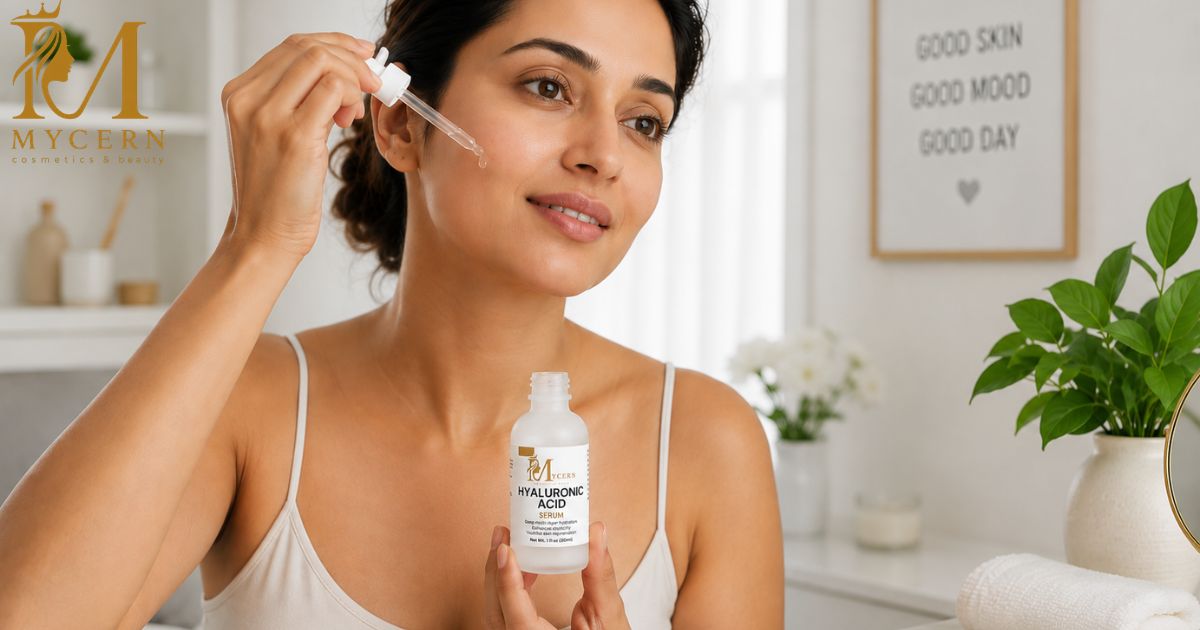
The honest answer is yes, but not in the dramatic, overnight way beauty marketing sometimes implies. The changes are real, they're grounded in skin biology, and they build over time. Here's what the research actually says.
✓ Medically Reviewed by Dr. Donika Vata, MD
Reviewed for scientific accuracy and wellness education.
Last reviewed: May 2026
MyCern is a US-based wellness brand creating research-supported, doctor-reviewed educational content.
The ingredients behind deep, lasting skin hydration.
The MyCern Hyaluronic Acid Serum combines multi-molecular hyaluronic acid, skin-barrier actives, and a lightweight, fast-absorbing formula — everything you need, nothing you don't.
See What's Inside →What Hyaluronic Acid Actually Is

First, let's clear something up: despite the word "acid" in its name, hyaluronic acid has nothing to do with exfoliation. It won't peel your skin or cause any of the sensitivity you might associate with AHAs or BHAs. It's actually a polysaccharide a type of sugar molecule that your body already produces naturally, found in your skin, joints, and eyes.
Its main job is to attract and hold onto water. A single molecule can bind up to 1,000 times its own weight in moisture, which is why it's become one of the most studied ingredients in topical skincare. According to research published in the Journal of Clinical and Aesthetic Dermatology, topical HA has been shown to meaningfully improve skin hydration and reduce the appearance of fine lines over an 8-week period.
Your skin produces HA naturally, but levels drop with age, sun exposure, and chronic stress. That's where a daily serum may help pick up the slack.
What Changes in the First Few Days
Most people notice something within the first two or three days, not a dramatic transformation, but a subtle shift. Your skin feels softer after cleansing. That tight, dry feeling you used to get in the morning is less pronounced. If you wear makeup, it starts applying more smoothly.
What's happening is fairly straightforward: HA is drawing water to the surface layers of your skin and temporarily increasing their water content. The result is a gentle plumping effect, particularly noticeable around areas prone to dehydration lines, like under the eyes and around the mouth.
These early changes are encouraging, but they're mostly surface-level. The more meaningful benefits come with consistent use over weeks.
What Consistent Daily Use Does Over Time
Skin hydration isn't a one-and-done situation it needs to be maintained. Think of it the way you think about drinking water. You can't drink a week's worth on Monday and coast through the rest of the week. Skin works the same way: it benefits from steady, daily hydration rather than occasional treatment.
Over weeks of daily use, people typically report improved skin texture, a more even tone, and a natural glow that doesn't require product to achieve. Fine lines caused by dehydration the kind that appear when your skin is parched rather than from age, become less visible as moisture levels stabilise.
Beyond appearance, hydration also plays a role in barrier function. A 2020 study in the International Journal of Molecular Sciences found that HA may support the structural integrity of the skin barrier, which helps protect against environmental stressors like UV radiation and pollution. A well-hydrated barrier is simply a more resilient one.
Hyaluronic Acid: What to Expect and When
| Timeframe | What You May Notice | What's Happening |
|---|---|---|
| Days 1–3 | Softer skin, smoother makeup application | Surface-layer hydration increasing |
| Week 1–2 | Plumper appearance, reduced tightness | Moisture retention stabilising |
| Weeks 3–6 | Improved texture, reduced dehydration lines | Barrier function strengthening |
| Month 2+ | Natural glow, more elastic skin feel | Cumulative hydration and barrier support |
Hydrated Skin vs. Moisturised Skin - They're Not the Same Thing

This is one of the most misunderstood distinctions in skincare, and it matters a lot for how you use HA. Hydration refers to the water content inside your skin cells. Moisture refers to the oils and lipids that form a protective barrier on the surface, preventing water from evaporating.
Hyaluronic acid is a humectant; it draws water in. It doesn't seal it there. That's the job of a moisturiser, which contains occlusives and emollients that lock the hydration in place.
If you apply HA and skip the moisturiser especially in a dry or air-conditioned environment, the molecule may actually pull moisture from your deeper skin layers rather than from the air, leaving your skin drier than it started. The fix is simple: apply HA to slightly damp skin and follow with your moisturiser before it fully dries.
Not All Hyaluronic Acid Works the Same Way
The molecular weight of HA, essentially the size of the molecule determines how deep it works in the skin. High molecular weight HA sits on the surface, creating a film that smooths and plumps immediately. Low molecular weight HA penetrates more deeply, delivering hydration to lower layers of the skin for longer-lasting effects.
Many quality serums, including the MyCern Hyaluronic Acid Serum, use a multi-molecular formula that combines both. Research from a study in Dermatology suggests that lower-weight HA may penetrate the epidermis more effectively than its larger counterpart, making multi-weight formulas worth paying attention to.
You've done the research. This is what it points to.
The MyCern Hyaluronic Acid Serum is formulated around the same science you just read — multi-molecular HA, clean ingredients, third-party tested for quality you can verify.
Shop Now →Common Mistakes That Get in the Way
Hyaluronic acid is one of the most forgiving skincare ingredients around, but a few easy mistakes can blunt its effectiveness.
Applying it to completely dry skin
Without ambient moisture to attract, HA has to look elsewhere, and it sometimes draws from your deeper skin layers. Mist your face lightly or apply straight after cleansing while skin is still slightly damp.
Skipping the moisturiser
HA draws water in; it can't keep it there without help. A moisturiser on top creates the seal that makes the hydration stick. In dry climates, this step is non-negotiable.
Using too much product
Two or three drops is genuinely enough. Using more won't boost results; it just leaves a sticky residue and burns through product faster than necessary.
Expecting anti-ageing results, it can't deliver
Hyaluronic acid targets dehydration, not structural ageing. Fine lines from collagen loss or chronic sun damage need different tools retinoids, peptides, vitamin C. HA makes a brilliant supporting player, but it's not a standalone solution for deep wrinkles.
Who Tends to See the Biggest Difference
Almost every skin type can get something from daily HA use, but certain people tend to notice the most obvious changes. If you have dry or dehydrated skin, you'll likely see results quickly. If you're already using retinoids or exfoliants, which are brilliant but can disrupt your skin barrier HA may help offset some of that dryness and sensitivity.
People who spend a lot of time in air-conditioned offices or heated rooms often find HA particularly useful, since both environments strip moisture from the air (and, in turn, from your skin). The same goes for anyone exposed to high levels of UV radiation, pollution, or other environmental stressors. You can read more about protecting your skin from daily environmental exposure in our broader guide to everyday wellness.
One thing worth noting: oily skin can also benefit. Oiliness and dehydration aren't mutually exclusive; in fact, skin sometimes overproduces oil as a compensatory response to dehydration. Addressing the dehydration directly may help bring oil production back into balance over time.
Can You Really Use It Every Day?
Yes and in most cases, twice a day is perfectly fine. Because HA is a molecule your skin already produces naturally, it rarely causes sensitivity reactions. There's no purge phase, no adaptation period, and no reason to cycle off it. You just use it consistently and let it do its job.
Consistency is the actual variable that matters here. Sporadic use produces sporadic results. The cumulative benefit of daily hydration, maintaining your skin's water content through every season, every environment, is what actually moves the needle over time.
Every batch of MyCern Hyaluronic Acid Serum is independently third-party tested by Eurofins, one of the world's largest and most respected testing networks. Testing covers heavy metals and microbiological safety, along with composition and active-ingredient verification to confirm the product's potency. MyCern Hyaluronic Acid Serum is also FDA-compliant for the US market. We believe quality should be something you can verify, not just something a brand claims.
Your wellness. Your formula.
Every person is different. The MyCern Supplement Advisor helps you find the product built for your specific needs — not a generic recommendation.
Get My Recommendation →When to See a Doctor
Skincare ingredients like hyaluronic acid are generally well-tolerated and are not a substitute for medical care. If you're experiencing any of the following, it's worth speaking with a qualified dermatologist or healthcare professional before making changes to your routine:
- Persistent skin redness, swelling, or irritation that doesn't resolve on its own
- Sudden changes in skin texture or tone that appear without a clear cause
- Allergic reactions itching, hives, or a burning sensation, after applying any new product
- Chronic or severe skin conditions such as eczema, psoriasis, or rosacea
- Any concerns about introducing a new product while on prescription topical treatments
Supplements and skincare may support general wellness, but they're not a replacement for professional advice. When in doubt, ask a doctor.
Frequently Asked Questions
How does hyaluronic acid actually work in the skin?
Hyaluronic acid is a humectant, a molecule that draws water toward itself. When applied topically, it attracts moisture from the environment and from deeper skin layers, holding it at the skin's surface to maintain hydration. It's a molecule your body already produces naturally, so it's recognised by the skin rather than treated as a foreign substance.
How long does it take to notice results from daily use?
Some people notice softer, more comfortable skin within the first few days. More visible improvements in texture, glow, and fine lines may take four to eight weeks of consistent daily use. Results may vary depending on individual factors, including your skin type, climate, and how you apply the product.
Is it safe to use hyaluronic acid every day?
For most people, yes hyaluronic acid is generally well-tolerated for daily and twice-daily use. It's non-irritating, doesn't cause photosensitivity, and works alongside most other skincare ingredients. Side effects are uncommon, though individual responses may vary. If you have a specific skin condition or are using prescription treatments, consult your healthcare provider before adding anything new to your routine.
What's the best way to apply a hyaluronic acid serum?
Apply two to three drops to slightly damp skin either right after cleansing or after misting your face lightly with water. Pat it in gently, then follow immediately with a moisturiser to seal the hydration in. Using it on completely dry skin in a low-humidity environment may reduce its effectiveness.
Who should be cautious about using hyaluronic acid?
Hyaluronic acid is suitable for most skin types, including sensitive and oily skin. That said, if you're pregnant, breastfeeding, managing a diagnosed skin condition, or taking prescription topical medication, it's always worth checking with a doctor or dermatologist first before introducing any new skincare ingredient.
References
- Pavicic T, Gauglitz GG, Lersch P, et al. Efficacy of cream-based novel formulations of hyaluronic acid of different molecular weights in anti-wrinkle treatment. Journal of Drugs in Dermatology. 2011;10(9):990–1000. PubMed: 21909382
This study evaluated the efficacy of HA-based creams across a range of molecular weights and found measurable improvements in skin hydration and wrinkle depth over eight weeks — relevant to the timeline data presented in this article. - Papakonstantinou E, Roth M, Karakiulakis G. Hyaluronic acid: A key molecule in skin ageing. Dermato-Endocrinology. 2012;4(3):253–258. doi:10.4161/derm. 21923
This review examines how HA content in the skin declines with age and how topical and injectable HA may support skin hydration and structural integrity — foundational to the science discussed in this post. - Ganceviciene R, Liakou AI, Theodoridis A, Makrantonaki E, Zouboulis CC. Skin anti-ageing strategies. Dermato-Endocrinology. 2012;4(3):308–319. doi:10.4161/derm.22804
Provides broader context for where hydration-based strategies like HA fit within the spectrum of evidence-based anti-ageing skincare — supports the distinction between addressing dehydration vs. structural ageing. - Juncan AM, Moiș DG, Santini A, et al. Advantages of hyaluronic acid and its combination with other bioactive ingredients in cosmeceuticals. Molecules. 2021;26(15):4429. doi:10.3390/molecules26154429
Reviews HA's mechanisms of action in cosmetic formulations, including multi-molecular weight strategies, and confirms its broad tolerability across skin types — supports the molecular weight section of this article. - Bukhari SNA, Roswandi NL, Waqas M, et al. Hyaluronic acid, a promising skin rejuvenating biomedicine: A review of recent updates and pre-clinical and clinical investigations on cosmetic and nutricosmetic effects. International Journal of Biological Macromolecules. 2018;120(Pt B):1682–1695. doi:10.1016/j.ijbiomac.2018.09.188
A comprehensive review of clinical evidence behind topical HA, covering efficacy in hydration, barrier support, and skin elasticity — directly relevant to the 'consistent daily use' outcomes discussed in this post.
Love this? Read more: From Brain Fog to Clarity: How to Optimise Your Cognitive Performance


