

You can take turmeric every day and still miss out on its real benefits. The reason is simple and surprising. Your body absorbs only a tiny amount of curcumin, the active compound in turmeric.
This is why curcumin absorption has become one of the most important topics in modern supplement science.
If you truly want to benefit from turmeric, you must understand how turmeric bioavailability works, why black pepper matters so much, and how to avoid common mistakes that block absorption.
This article explores:
-
Why curcumin is so poorly absorbed in the body
-
How black pepper dramatically improves curcumin absorption
-
The science behind piperine curcumin absorption
-
Which turmeric supplement absorption formats work best
-
How to choose an effective turmeric supplement for real results
Why curcumin is so poorly absorbed

Curcumin is powerful, but your digestive system struggles to use it.
The main problem is chemistry.
Curcumin does not dissolve well in water. Your gut is a water based environment, so only a small amount can pass through the intestinal wall. On top of that, once curcumin enters your body, your liver quickly converts it into forms that are much less active. Then it is removed from the bloodstream very quickly.
This is the core reason behind low turmeric bioavailability.
In simple terms, you can swallow a large dose of turmeric, but most of it never reaches your tissues.
Many curcumin bioavailability studies have shown that even very high doses of curcumin produce extremely low blood levels when taken alone. This is why people often say turmeric “does nothing” for them.
The problem is not turmeric itself.
The problem is absorption.
Why black pepper changes everything
The biggest breakthrough in curcumin absorption came when researchers discovered the role of black pepper.
Black pepper contains piperine, a natural compound that changes how your body handles curcumin.
When curcumin is taken together with piperine, its absorption increases dramatically. Research shows that black pepper curcumin combinations can raise bioavailability by up to 2,000 percent.
This is why piperine curcumin absorption is now considered essential for effective turmeric supplementation.
Piperine works in three main ways:
-
It slows down the enzymes in the liver that rapidly break down curcumin
-
It helps curcumin stay in its active form for longer
-
It improves how easily curcumin passes through the gut wall
Without piperine, most curcumin is eliminated before it can support inflammation balance or antioxidant activity.
This is why modern turmeric formulas almost always include black pepper extract.
The correct curcumin and piperine ratio

More piperine is not always better.
Research suggests that effective black pepper curcumin formulations usually use about:
-
500 mg curcumin
-
with 5 to 10 mg piperine
This ratio is enough to significantly enhance absorption without increasing the risk of digestive discomfort.
When reviewing supplements, look for clearly listed black pepper extract or piperine content, not just “black pepper” as a vague ingredient.
Other ways to improve turmeric bioavailability
Although piperine is the most important factor, other strategies can further support turmeric bioavailability.
Taking curcumin with fat
Curcumin is fat soluble. This means it absorbs better when taken with meals that contain healthy fats such as:
-
olive oil
-
avocado
-
nuts
-
eggs
-
fatty fish
Even the best black pepper curcumin formula benefits from being taken with food.
Advanced delivery systems
Some products use:
-
phospholipid complexes
-
liposomal delivery
-
micronized or nano sized particles
These approaches can improve turmeric supplement absorption by helping curcumin disperse more easily in the digestive tract.
However, most of the strongest and most consistent human evidence still supports combining curcumin with piperine.
Curcumin delivery formats and absorption

Capsules
Capsules are the most common format. They work well when they contain both curcumin and piperine and are taken with food.
Softgel capsules may offer a small advantage because curcumin is suspended in oil, but food intake still matters more than capsule type.
Powders
Powders offer flexibility, but absorption is more difficult to control. You must manually add black pepper and consume fat at the same time to support absorption.
Without this, turmeric supplement absorption from powders remains very limited.
Gummies
Gummies are becoming popular because they improve consistency. Many people stop using capsules simply because they forget or dislike swallowing pills.
When formulated properly, gummies that contain both curcumin and piperine and are taken with meals can support effective daily intake.
Consistency matters just as much as formulation.
Common mistakes that block curcumin absorption
Taking turmeric on an empty stomach
This is one of the most common mistakes. Without fat, curcumin absorption is much lower.
Choosing products without absorption enhancers
Many products still contain only turmeric powder or curcumin extract without black pepper. These products fail to address the core bioavailability problem.
No matter how high the dose, absorption remains poor without enhancement.
Stopping too early
Curcumin works gradually. It supports long term inflammatory balance and antioxidant protection. Most people need at least four to eight weeks of consistent intake before noticing benefits.
Expecting fast results
Curcumin is not a painkiller or stimulant. It supports underlying biological processes. Its benefits develop over time.
How to choose a turmeric supplement that actually works
When selecting a product, focus on these essentials:
-
standardized curcumin extract, usually listed as 95 percent curcuminoids
-
black pepper extract or piperine clearly listed
-
reasonable dosing, usually 500 to 1000 mg curcumin per day when combined with piperine
-
clear quality testing and transparency
High milligram numbers alone do not mean better results. Absorption quality is more important than raw dose.
This is the key lesson from modern curcumin bioavailability studies.
How MyCern supports better curcumin absorption

At MyCern, our formulation philosophy focuses on both science and real life use.
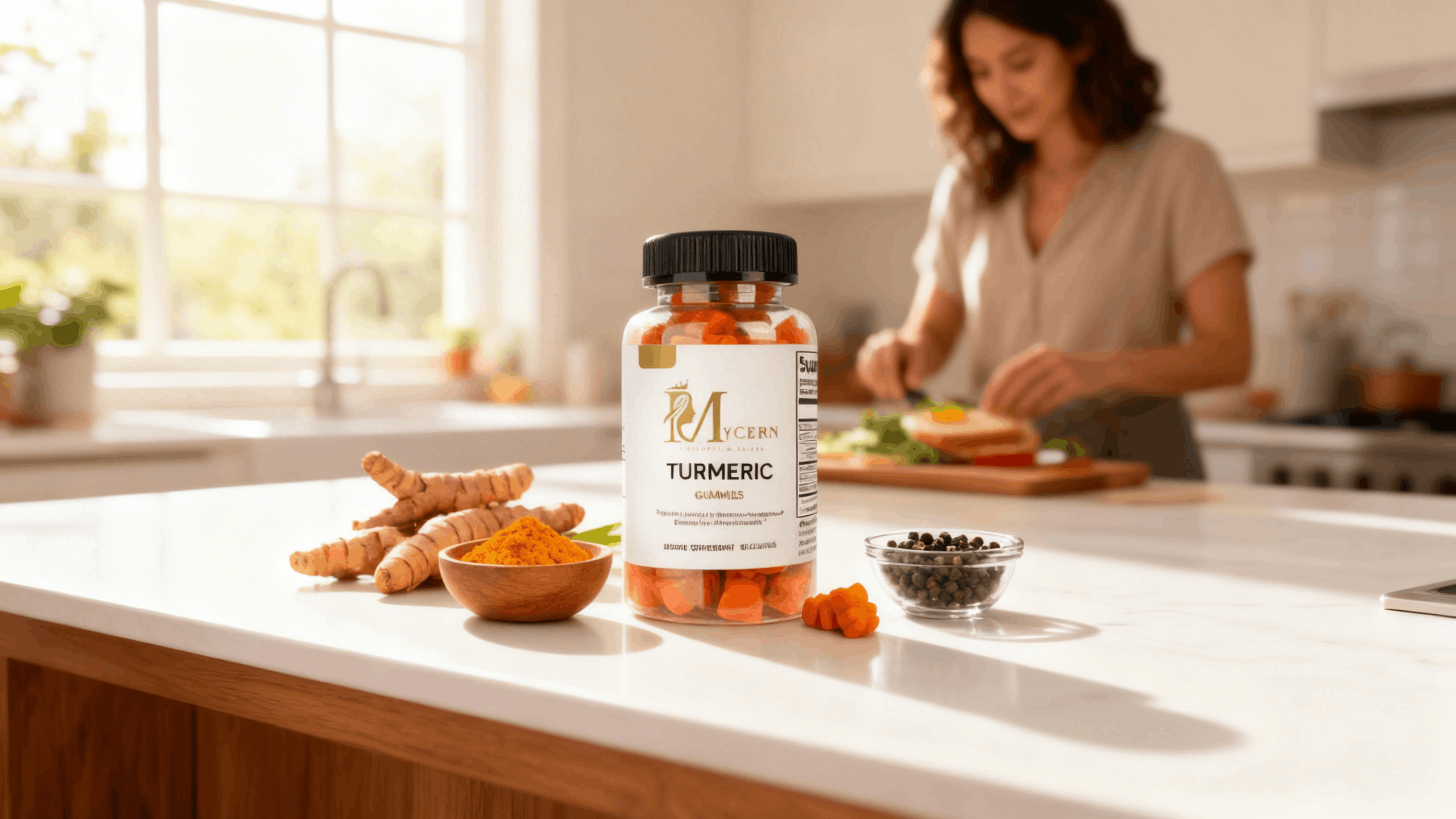
MyCern Turmeric Gummies are designed specifically to address the curcumin absorption challenge. Each serving provides standardized curcumin combined with black pepper extract delivering piperine in the research supported range.
This allows the body to benefit from proven black pepper curcumin synergy rather than relying on curcumin alone.
The gummy format also supports consistency, which is one of the most overlooked aspects of successful supplementation. A well designed formula only works if people actually take it daily.
By combining:
-
standardized curcumin
-
piperine for enhanced piperine curcumin absorption
-
and a user friendly format
MyCern supports practical, science guided turmeric supplementation for everyday wellness routines.
How to use turmeric for best results
For optimal turmeric supplement absorption:
-
take your supplement with a main meal
-
make sure the meal contains some healthy fat
-
use the product daily for at least six to eight weeks
-
avoid taking turmeric at the same time as strong digestive discomfort episodes unless advised by a professional
If your daily dose is higher, splitting it into two smaller servings with different meals can help maintain steadier blood levels.
Safety considerations
Curcumin is generally well tolerated.
However, consult a qualified healthcare professional before using turmeric supplements if you:
-
take blood thinning medications
-
have gallbladder issues
-
are preparing for surgery
-
are pregnant or breastfeeding
-
use prescription medications that are metabolized by the liver
Piperine can slightly affect how certain medications are processed, so professional guidance is important for long term use alongside prescriptions.

Conclusion
Understanding curcumin absorption is the real key to unlocking turmeric’s benefits.
Curcumin on its own has very low bioavailability. This is why black pepper matters. The combination of curcumin with piperine dramatically improves how much your body can actually use, making black pepper curcumin formulations the most practical and evidence supported option for everyday supplementation.
Modern curcumin bioavailability studies clearly show that formulation quality matters more than dosage alone. Whether you choose capsules, powders, or gummies, the fundamentals remain the same. You need standardized curcumin, effective piperine curcumin absorption support, and consistent daily use with meals.
When turmeric bioavailability is addressed correctly, turmeric becomes far more than a trend. It becomes a meaningful, long term tool for supporting antioxidant protection and healthy inflammatory balance as part of a well designed daily wellness routine.
References
-
Anand, P., Kunnumakkara, A. B., Newman, R. A., & Aggarwal, B. B. (2007). Bioavailability of curcumin: problems and promises. Molecular pharmaceutics, 4(6), 807-818.
-
Hewlings, S. J., & Kalman, D. S. (2017). Curcumin: A review of its effects on human health. Foods, 6(10), 92.
-
Prasad, S., Tyagi, A. K., & Aggarwal, B. B. (2014). Recent developments in delivery, bioavailability, absorption and metabolism of curcumin: the golden pigment from golden spice. Cancer research and treatment: official journal of Korean Cancer Association, 46(1), 2-18.
-
Shoba, G., Joy, D., Joseph, T., Majeed, M., Rajendran, R., & Srinivas, P. S. S. R. (1998). Influence of piperine on the pharmacokinetics of curcumin in animals and human volunteers. Planta medica, 64(04), 353-356.
-
Stohs, S. J., Chen, O., Ray, S. D., Ji, J., Bucci, L. R., & Preuss, H. G. (2020). Highly bioavailable forms of curcumin and promising avenues for curcumin-based research and application: a review. Molecules, 25(6), 1397.


